Last week I called the Custer County Sheriff’s Office to inform them that we were going to burn four big piles of slash. The nice lady who answered the phone took down our address and phone number and said to be careful. I said careful was our watchword, which was why we were burning when there were three inches of fresh snow on the ground.
The slash piles were sitting out toward the river in sagebrush and uncut willows. They had been there since last summer, when we had worked on house-adjacent fire prevention, removing the lower branches of lodgepoles and cutting down the willow bushes that had begun to take over the lawn.
By fall, the piles had grown enough to be impressive fire hazards in their own right. We would burn them when the snow came.
The snow didn’t come. Rain came instead. Burning them was safe enough, if we could get a fire started. We couldn’t.
March was a sunny and dry month, with warm days and cold nights, and the valley floor dried out quickly. From experience, we knew better than to set fires in the middle of wind-dried brush and grass, even if they were growing out of frozen puddles. We waited for an April snowstorm. It arrived, in the form of three inches of slush.
When warm weather dried the piles out again, we covered them with sheets of plastic. The next time it snowed, I drove to town and bought three gallons of diesel for $5.69 a gallon. (That’s what it will cost you if you drive north from southern Idaho and fill up your giant diesel pickup in Stanley. Way smarter to take the Prius instead.)
We pulled the plastic off the slash piles, poured diesel into the middle of them, and set all four on fire. Three of them burned to the dirt.
We had piled the fourth in an overflow channel. It was sitting in eight inches of meltwater. It burned down to the waterline in spots, but wasn’t enthusiastic about it. In the coming weeks I’ll put on hip boots and drag a bunch of oily half-burnt limbs onto higher ground, where they will form the nucleus of our next slash pile.
In the meantime, the backyard smells like diesel. We won’t start fires that way again, even if we can afford it. Next fall, when the new pile is the size of a small house, we’ll pull a big tarp over it, which will keep it tinder dry. Once the snow comes, we’ll wait for a sunny day, pull the tarp off, and set a match to it.
But only if it snows. Only if our valley hasn’t already burned during fire season.
________
Climate change has already happened. People are refugees because of it. People are dying of heat stroke and starvation and drowning because of it. If you deny climate change, you’re denying history.
Denying history means you ignore the vast blackened forests of the American West, the pyroclastic clouds that pierce the horizons every July through October, and the warm river water and mossy streamers and floating dead trout of August. You ignore the deep dust on mountain trails, the black and sterile rocky ridges where sagebrush and scrub lodgepole once grew, the heat that makes hiking dangerous, the body-paved beaches of lakes and reservoirs whenever the temperatures go over 100 degrees Fahrenheit in the cities. In the winters you ignore the bare slopes surrounding the artificial snow of ski runs, the December rain that pools on ground that froze in November. You turn off reports of record high temperatures and record high low temperatures. You plug your ears to news of marine heat waves, catastrophic rainstorms, and heat-stroke fatalities on formerly temperate California hiking trails.
A major El Niño is forecast to arrive in the mid-Pacific by August. Average Northern Hemisphere days and nights will be two or three or four degrees Fahrenheit over what the Boise weather reporters call normal. I await the day air quotes accompany the word “normal” whenever it’s mentioned on the local stations.
________
In 1952, the American science-fiction author Robert Heinlein published “Year of the Jackpot,” an apocalyptic story describing a year when all measurable cycles of history—economic, climatic, political—either peak or bottom out at once. The story features people spontaneously removing their clothes in public, rampant transvestism (remember this was 1952), contagious religious frenzies, economic chaos, continent-wide droughts and floods, a nuclear war mostly cancelled by bad weather (a nuclear weapon does wipe out Los Angeles), and finally, the sun going nova.
Humans are described as lemmings by the story’s narrative character, a statistician who works as an insurance consultant. Individual humans might be outliers on a graph, but humans as a species engage in rigid cyclical behavior. So apparently does the cosmos.
I read “Year of the Jackpot” as a twelve-year-old, but it’s stuck with me for 63 years. With the current climate of weather catastrophe, AI-created reality, pointless wars, the worst full of passionate intensity and so on, Heinlein’s jackpot year seems to have arrived. The only thing missing is the sun blowing up and eliminating all life on the planet, and then, novas being what they are, the planet itself.
Our understanding of astrophysics has improved since 1952. The sun won’t go nova, and it won’t even turn into an Earth-swallowing red giant for a billion years or so. But a new and improved astrophysical future is small comfort when you consider we are creating a climate capable of eliminating life down to the extremophiles that live in Yellowstone hot pools.
A not-so-fun fact: even if we reduce greenhouse gases to pre-industrial levels, the grow-or-die feature of extractive capitalism will produce enough waste heat to boil the oceans in 400 years. As far as I know, no economics class in the world teaches that dismal truth. It remains up to physics to explain the Second Law of Thermodynamics.
I’ve yet to hear of any university that has subsumed its economics department into its physics department.
________
Lemmings have turned out not to have a death wish after all. The source of that myth was the 1958 Disney documentary, White Wilderness, where hundreds of them leap off a high cliff into a vast (for a lemming) body of water. The scene was really a bunch of kidnapped lemmings from the far north being herded off an Alberta cliff by photographers’ assistants.
The whole process—lemmings being live-trapped and sold by Inuit children in the far north, loaded on planes and flown a thousand miles south of their habitat, pushed off a cliff into a lake, where they swam for a while before sinking—could serve as a PETA fundraising video.
Because I was a credulous eight-year-old, I walked out of the theater believing that lemmings would periodically go crazy and kill themselves.
I now believe the legends that a few ancient lemmings, after years of dodging oil trucks on Canadian highways, escaping wolf packs and forest fires, learning to swim cascading rivers and muskeg swamps, finally made it back to their homeland, where they were revered for their ability to choose to go on living in the face of the incomprehensibly cruel lemming-gods.
Turns out that the movie was really about humans, a fact that escaped the Motion Picture Academy long enough for them to give White Wilderness an Oscar.
Turns out it is humans, not lemmings, that spontaneously stampede to suicide, start wars, refuse to vaccinate, deliberately starve children, willingly enact the savage rituals of their ancestors, and believe what they see and read on Facebook and X. They don’t seem to have a choice in these matters.
One struggles to reconcile a healthy urge toward self-preservation with belonging to a species with a death-wish.
________
Most long-range weather forecasts for our valley say we’ll have a hot and dry summer, but meteorologists have become wary of prediction. Worldwide weather is a complicated enough system even when you don’t mess with its variables, and humans are messing with ocean temperatures, ocean currents, atmospheric water, and planetary albedo. In Southeast Asia the heat is getting so bad that the tourist experience there consists of brief forays to the beach or Buddhist temples separated by long stays in air-conditioned hotel rooms and restaurants. Florida is in a drought and is experiencing record wildfires. Spain and Portugal are flooding after record rainstorms. It’s hard to find a place on the planet where the weather hasn’t recently been lethal.
The good news is that you no longer need to travel to become a tourist, as long as you can afford a climate-controlled room with no windows except the one provided by an 85-inch QLED screen and a travel channel.
It saves the cost of a plane ticket and passport if you stay in your city, the cost of a hotel and restaurant if you stay in your own home. You just turn down the thermostat, watch travelogues on the big screen, and call for takeout. On the other side of the walls is a heat-island wasteland, but only for the homeless.
________
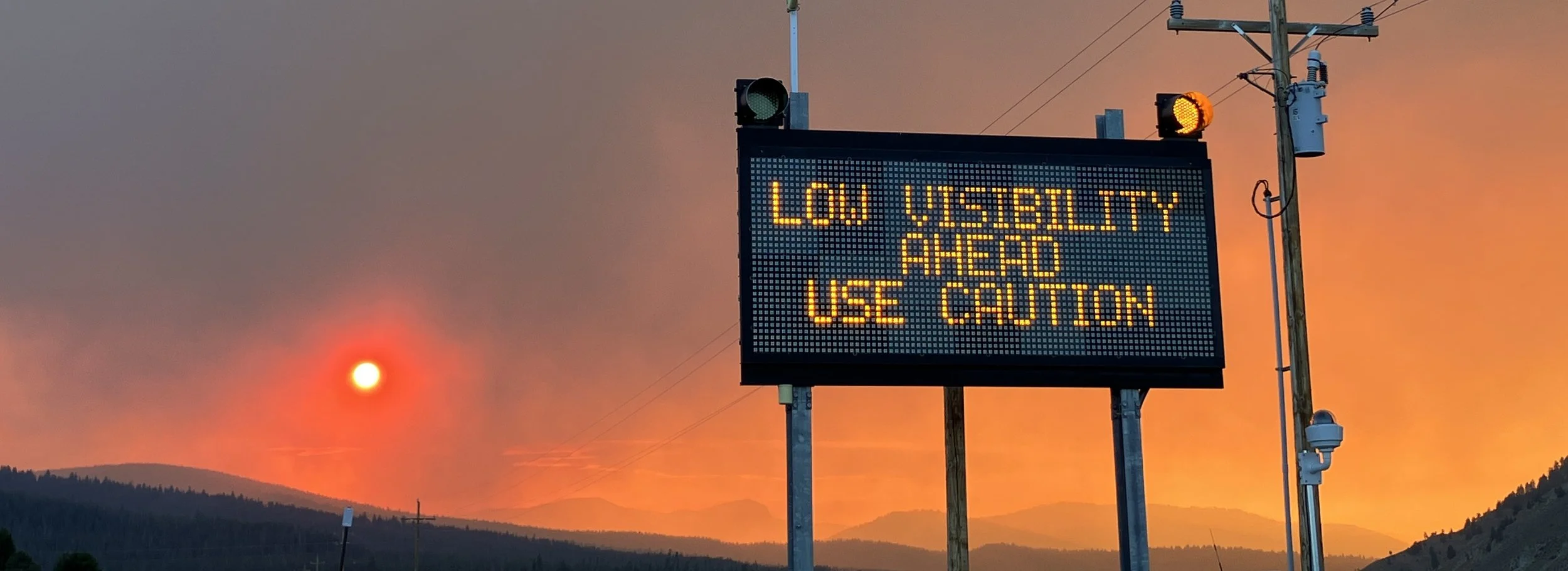
Here, we have learned to expect opaque and hazardous air by August. The tourists disappear as highways close and air-quality alerts are broadcast.
Between fires we might get lightning and thunder, cloudbursts, flash floods, microbursts that level every tree in a campground, hillsides that become mudslides.
We don’t worry that a sudden cold front could sweep down from Canada and we’d awaken to six inches of snow on the ground in July. That’s happened in the past, but I’ll be braver than our local weather people and say that’s the one thing that won’t happen this summer.
________
When a wildfire raged four miles from us two Julys ago, two nice young men from the Forest Service assured us that our house and garage were reasonably defensible. They said that if the trees across the river started to burn, they’d park a fire engine in our driveway and protect the place. Since then we’ve seen videos of the mega-fires in British Columbia and the house-to-house infernos in the suburbs of Los Angeles, and we don’t believe that they’ll stick around for a firestorm.
By August we’ll have the pickup in the driveway, pointed toward the highway, ready to load what we can and flee the flames.
Fires aside, we also fear that we’ll be swamped by people who visit and won’t go home. That’s how you tell refugees from tourists: their vacations end, but they’re still here, coming to your door and wondering if you’ve got any food for their kids or diesel for their pickups.
________
These worries seem far-fetched, but they’ve happened in other places, in other times, and I take that to mean they could happen again.
What is more likely this summer is that people will begin to throw off the comfortable mantle of denial that has protected them from realizing that the Covid pandemic, Putin’s invasion of Ukraine, the destruction of Gaza, and Trump’s second term have changed what we experience as real.
We can expect bad craziness. Humans aren’t built to stay sane when a culture-created world begins to melt around them.
The Custer County Sheriff’s Office will have far more to do than keep track of people’s slash-burning. It will be a shock to them and to us.
________
We’re doing what we can. We’re preparing for fire and flood. We’re referring to the Old Testament to see what else the future might have in store. If we continue to mow and water the lawn as in past years, that’s because ritual is a calming activity, one that keeps time comfortably circular and lawns relatively fire-proof.
We’re staying sane, mostly by loving and taking care of each other, being kind to others when the opportunity arises, and trying not to piss anybody off.
But as summer approaches, our sense of agency is taking a beating. We feel like we’re being herded toward a cliff, and it’s going to be a long involuntary fall off the edge.